
Sofia Pavkovic on Kyla William Tate’s “AI, Archives, and the Afterlives of Data”
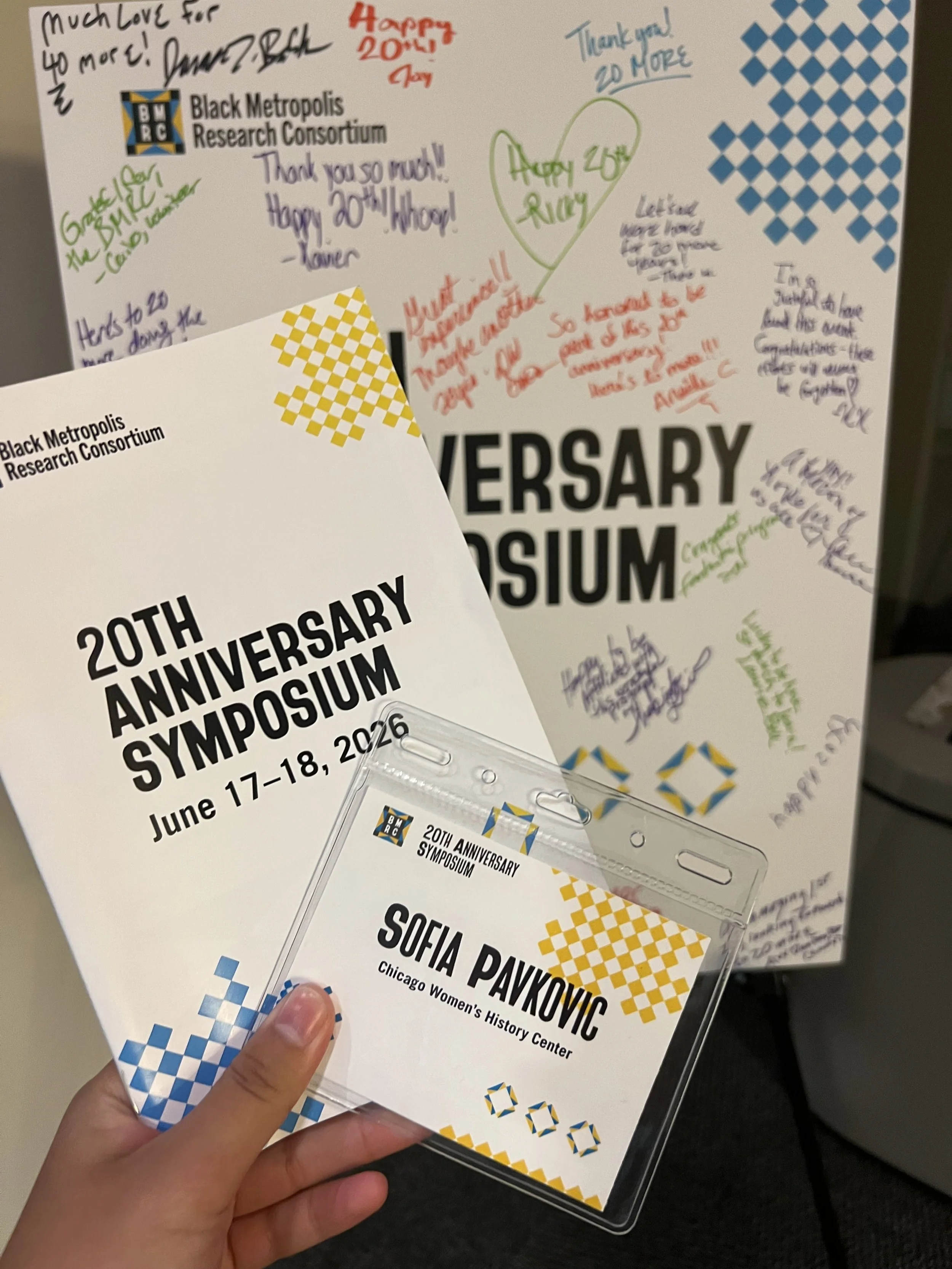
As a young person looking at graduating from undergraduate in the coming year, I have learned to fear AI and what it’s doing to the job market. At commencement ceremonies across the nation, speakers who heralded AI were met with choruses of boos from anxious graduates who knew that for them, AI was only going to make things harder. While I’ve been anxious about these developments, looking at a career in archives, museums, and cultural institutions, I knew that AI wasn’t going to directly impact my post-grad job search as much as it would in a field like computer science or finance. However, when I attended the Black Metropolitan Research Consortium’s 20th Anniversary Symposium on June 18th, I learned how AI might be creeping its way into the staunchly analog archives field.
While every speaker was urgent, incisive, and poignant in their work and presentations, the talk that most stood out to me was Kyla Williams Tate’s, titled “AI, Archives, and the Afterlife of Data: Preserving Black Stories Ethically.” Tate began her talk with a different AI – Ancestor Intelligence – and spoke about her elderly mother’s request that she find proof that her father existed before she dies. Tate, an experienced researcher, searched in archives and public records and was unable to find a single trace. Tate used her grandfather’s absence from the record to demonstrate how every dataset tells a story, and we must question what and whose story the data is telling.
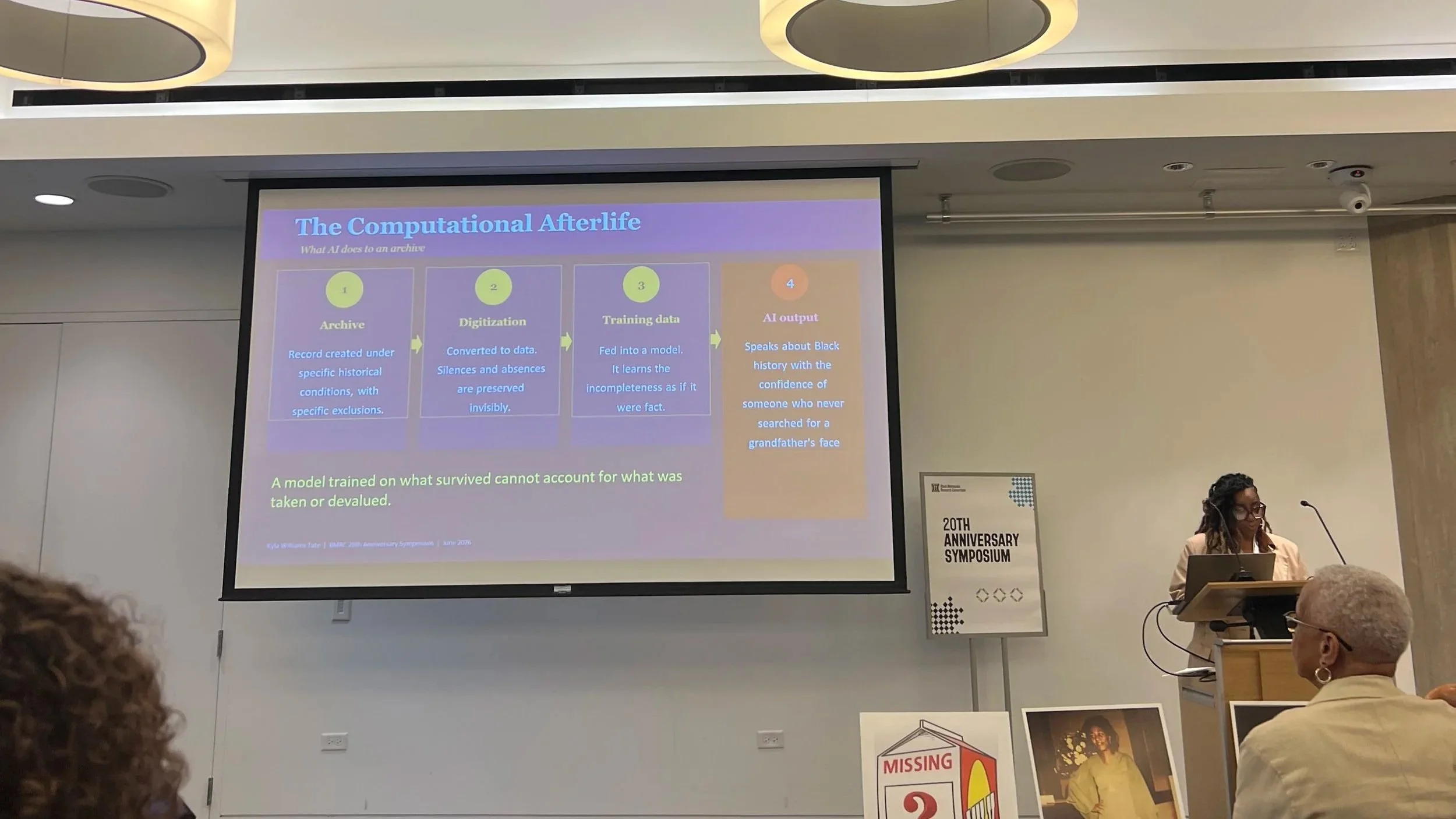
Tate moved on to discussing the ways in which Black stories are impacted by Artificial Intelligence. Firstly, Black stories are largely absent from historical archives. The limited Black presence that remains is then used without consent to train generative AI systems, further misrepresenting and distorting these already vulnerable histories. Generative AI learns only the partial record and regurgitates it as fact – it is trained on what survived and cannot account for what was taken or devalued. The result? Generative AI “speak[s] about Black history with the confidence of someone who never searched for a grandfather’s face.”
These AI systems are then dangerous, especially in the gap between what the archives hold and what communities know. Tate used the example of Chicago Police Department tools that use AI to further criminalize and surveil Black neighborhoods. For instance, the CPD’s “Strategic Subject List” is a list of 400k Chicago residents who are “at risk” to commit crimes. The list’s subjects are 70% Black, and their names are on this list without their consent in spite of the fact that they have had no hearing and committed no crime. These are the results when AI is trained on racially biased, partial data from the archive.
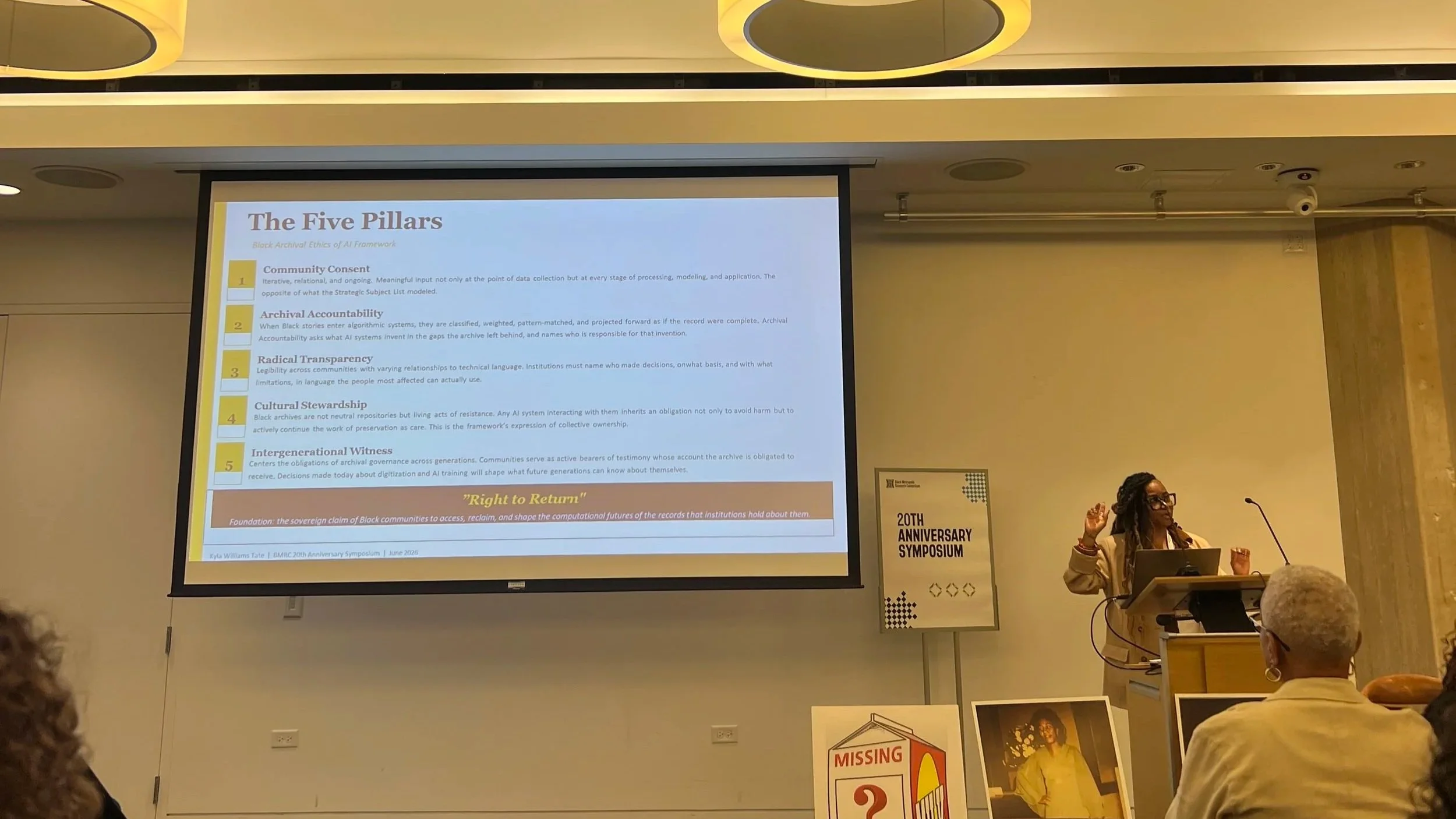
While AI’s interference in archives has already had negative effects on Black communities, there are ways that communities and institutions work against its influence. The Black Metropolitan Research Consortium is an example of what Tate calls “the counter-algorithm,” the human system of memory and documentation. The BMRC enacts the counter-algorithm institutionally, a non-neutral process of corrective memory that fills the gaps in dominant archives. Another way that Tate says we can work to fill the gap is through using “Poetry as Epistemology.” Tate points to poets like Gwendolyn Brooks, Eve Ewing, and avery r. young to show how poems hold the cultural information and memory that datasets do not. “Black poems are evidence,” she says. “They hold what census records omit, what finding aids cannot index, and what AI systems will systematically miss.” As an English Literature major pursuing a career in archives, these words were a revelation for me. My love for history and for poetry has always been intertwined, and Kyla Williams Tate put the unsaid reason why into words. Tate didn’t stop there. Asking, “What does a governance framework look like that starts from what poetry knows?” Tate called for poets, artists, and other creative community members to be included in governance conversations about AI ethics. She displayed her “5 Pillars” framework for Black Archival AI ethics and outlined what institutions can do to help interrupt this issue before AI quietly rewrites history.
The room was stunned by Tate’s presentation – her grip on the assembled academics and archivists was undeniable. Part of this crowd, I too found her talk incredibly engaging and enlightening. As I mentioned at the beginning of this blog post, I am graduating into a job market defined by AI. Algorithms and AI read your resume and job applications before they ever reach a set of human eyes; Your interviewer uses an AI transcription service in your Zoom interview (or you may be even interviewed by an AI chatbot); Your job (never secure) involves less doing tasks yourself and more prompting Claude or ChatGTP to do them for you. Going into a world of mostly-analog archives, museums, and cultural institutions, I thought I would be shielded from this image of the new American workplace. I thought that the ratio of digitized material as compared to what collections store physically – once described to me as like a drop to the ocean – meant that AI didn’t have enough information to get trained off of archival collections. However, as Tate demonstrated most eloquently in her talk, for generative AI, an AI system that is working with an absence of information is much more dangerous than one that has a wealth of information at its disposal.
I left the talk renewed in my conviction to dedicate my career to archiving, preserving, and protecting marginalized histories. As AI continues to evolve, it is up to archives, museums, and cultural institutions to defend the vulnerable histories they hold and confront the gaps in their collections.
By Sofia Pavkovic, Summer Intern, July 9th 2026
P.S. – Many thanks to the Chicago Women’s History Center for providing me with a ticket to this symposium.
