Maria Kahn on Unheard Voices of Care: Filipino Nurses in America
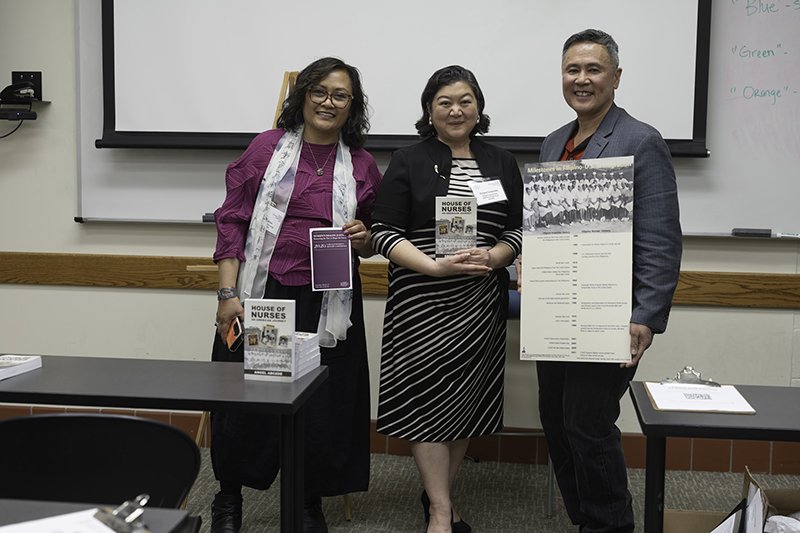
From left to right: Xyla Gatilao (CWHC President), and presenters; Ginger Leopold and Angel Accede, Photo credit Diana Solis at Chicago Women’s History Conference 2026
The panel discussion evoked a sense of community within its audience, comprising people from completely different walks of life. It discussed the interactions of Filipino nurses as they first migrated to the U.S. and how stereotypes continue to shape both professional and familial experiences. The speakers discussed the journey and struggles in a manner that felt universal and relatable across immigrant communities.
Angel Abcede and Ginger Leopoldo perfectly complemented each other in their commitment towards sharing Filipino immigrant stories and dismantling stereotypes by combining their art and advocacy. With Abcede, a journalist, having just written his book tracing the lives of his mother and two aunts. To Leopoldo, a multi-disciplinary artist and organizer dedicated to preserving Filipino American history, as represented through her work at CIRCA Pintig and the Filipino American National Historical Society Greater Chicago Chapter (FANHSC). Both speakers discussed their work together developing an exhibit representing the journey of Filipino nurses in the U.S., which was to be inaugurated at the International Museum of Surgical Science on May 15 2026.
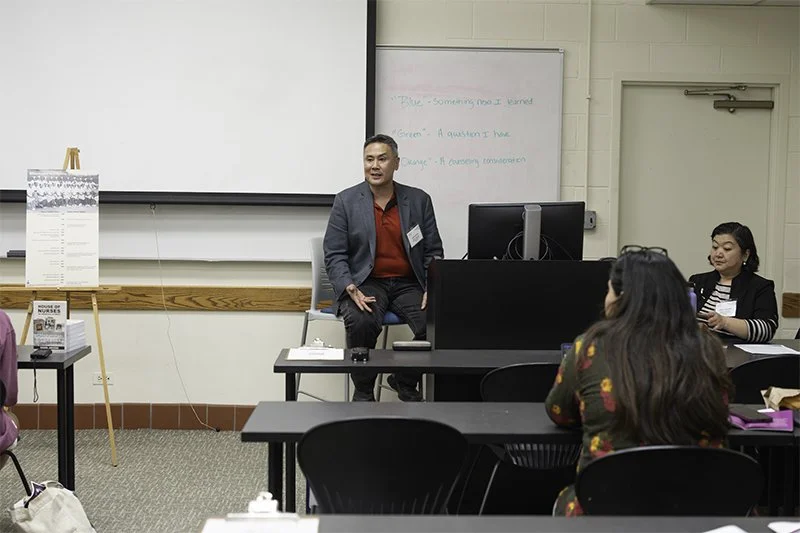
Angel Abcede presenting at Chicago Women’s History Center sharing an excerpt from his book: House of Nurses: An American Journey
Photo credit Diana Solis
The session largely focused on Abcede’s recent book, ‘House of Nurses: An American Journey’. The discussion of the book took us through the timelines of three sisters and their migration from the Philippines to the U.S., only made possible by virtue of being nurses. Leopoldo’s riveting performance reading the chapter relating to the elder sister’s nursing career in the Philippines at the time of the Japanese invasion and the seizure of the hospital she worked in, her successful escape, reunion with her family, and eventual journey to the U.S. moved the audience to tears. The speakers also discussed the later chapters in the book, including those relating to the youngest sister and Abcede’s aunt, and her time living in a house in San Francisco with 16 women who were either already nurses or were studying to become one. In stark contrast to the previous chapter, the reading of this chapter had the room laughing as Leopoldo recreated the house of nurses' environment using Abcede’s words. It represented the other side of Filipino nurses' lives, not just as professionals in immigrant communities but also as women experiencing girlhood in America.
It was truly remarkable how brilliantly the speakers managed to balance the discussion of the historic struggles and the stereotypes that prevail to this date, with the celebration of the community’s successes and joys. On one hand, they highlighted the nuances of the stereotypes within the healthcare system, media, and the wider society despite the long-recorded importation of Filipino nurses by the U.S.. On the other hand, they discussed the erasure of the community from the popular media’s depiction of nurses in the U.S. as an intentional dismissal of the medical and professional competence of Filipino nurses.
That is precisely why the work of Abcede and Leopoldo remains more important than ever. Their work educates its audience on the manner in which Filipino nurses were treated as commodities being exported to the U.S., especially in the wake of different medical crises following the war, the HIV and AIDS epidemic, and most recently, COVID-19. It is informed by the context in which many Filipino women led their families' migration to Guam, by how they built communities and dealt with Western values that seemed bizarre to them at the time, and by how they continue to serve the American healthcare system and their communities alike.
By Maria Kahn, Scholarship Attendee, May 8, 2026
Exhibition opens May 15, 2026: The journey of Filipino Nurses in the U.S., at the International Museum of Surgical Science on May 15 2026